Medically reviewed by Dr. Thirumagal, MS (OG), LIVF Fertility & Women’s Healthcare · Updated November 2026
Quick answer: ICSI (intracytoplasmic sperm injection) is a step inside IVF. In regular IVF, eggs and many sperm are placed together in a dish and fertilisation happens on its own. In ICSI, an embryologist injects a single sperm directly into each mature egg. ICSI is mainly used when sperm count or movement is very low, when sperm are taken surgically, or when eggs did not fertilise in a previous IVF cycle. For couples without a sperm problem, guidelines say regular IVF usually works just as well.
What is ICSI?
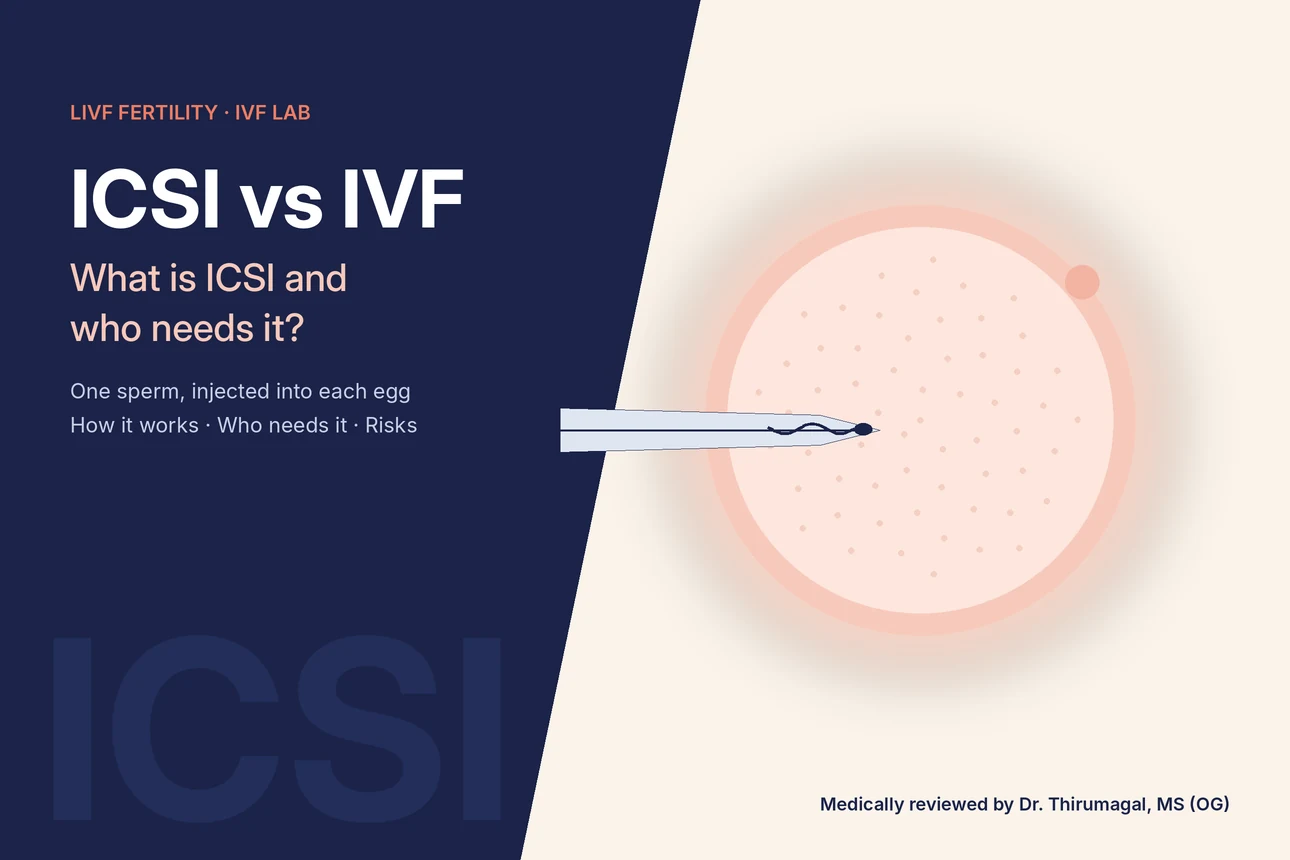
ICSI stands for intracytoplasmic sperm injection. “Intracytoplasmic” means inside the egg. Under a high-power microscope, the embryologist picks one healthy-looking, moving sperm, draws it into a very fine glass needle and injects it into the centre of a mature egg.
ICSI was first used successfully in 1992 and is now one of the most widely used lab techniques in fertility treatment. It is not a separate treatment from IVF. It changes only how the egg is fertilised in the lab. Everything else, the injections, egg collection and embryo transfer, stays the same.
ICSI vs IVF: what’s the difference?
| Conventional IVF | IVF with ICSI | |
|---|---|---|
| How fertilisation happens | Each egg is placed with about 50,000 to 100,000 moving sperm; one sperm enters on its own | One selected sperm is injected into each mature egg |
| Sperm needed | A good number of moving sperm | Only one sperm per egg; works even with very few sperm |
| Main use | Tubal problems, PCOS/PMOS, unexplained infertility, mild male factor | Severe male factor, surgically retrieved sperm, previous fertilisation failure |
| Eggs that can be used | Mature eggs | Only mature eggs (immature eggs cannot be injected) |
| Lab steps | Standard | Extra skilled micromanipulation step |
| Cost | Base IVF cost | Usually a little more than base IVF |
Medicines, scans, egg collection and embryo transfer are the same for both. (New to IVF? Read IVF vs Test Tube Baby: Are They the Same?)
How does the ICSI procedure work?
- Ovarian stimulation: hormone injections for about 8 to 12 days to help several eggs grow, checked with scans and blood tests.
- Egg collection: a short procedure under sedation, guided by ultrasound, to collect eggs from the ovaries.
- Sperm sample: the partner gives a fresh sample the same day, or frozen sperm is used. If there are no sperm in the semen, sperm may be retrieved from the testis by a minor procedure.
- Injection: the embryologist removes the cells around each egg, checks which eggs are mature, and injects one sperm into each mature egg.
- Embryo culture: the next day, fertilised eggs are checked. Embryos are grown in the lab for 3 to 5 days.
- Embryo transfer: one embryo is placed in the uterus. Good-quality extra embryos can be frozen for later use.
Who needs ICSI?
Your doctor may suggest ICSI if:
- Sperm count is very low or very few sperm are moving. Read: Semen Analysis Report Explained.
- Sperm shape (morphology) is severely abnormal.
- There are no sperm in the semen (azoospermia) and sperm are retrieved surgically from the testis or epididymis.
- Eggs did not fertilise, or very few fertilised, in a previous regular IVF cycle.
- Frozen sperm are being used, especially if the sample is small, such as sperm frozen before cancer treatment. Read about sperm freezing.
- Frozen eggs are being thawed and used.
- Genetic testing of embryos (PGT) is planned, so that extra sperm stuck to the egg do not affect the test.
- Antisperm antibodies are present.
Does everyone doing IVF need ICSI?
No. This is a common question, and the answer surprises many couples. For couples without a sperm problem, studies and guidelines from bodies such as ASRM and ESHRE have found that routine ICSI does not lead to more live births than conventional IVF. It adds a lab step and cost without a clear benefit in these cases.
So the choice between IVF and ICSI should be based on the semen report, previous IVF results and the couple’s situation, not used for everyone by default.
Is ICSI safe? What are the risks?
ICSI has been used for over 30 years, and most babies born after ICSI are healthy. The points to discuss with your doctor:
- Same risks as IVF: ovarian hyperstimulation syndrome (OHSS), multiple pregnancy if more than one embryo is transferred, and the small risks of egg collection.
- Egg damage: a small number of eggs may be damaged during injection.
- Inherited male infertility: some causes of severe male infertility are genetic, for example Y-chromosome microdeletions. These can be passed to a son, who may also have fertility problems later. Men with very low counts are often advised a karyotype and Y-chromosome test before ICSI.
- Birth defects: some studies show a slightly higher rate than in natural conception, but much of this seems linked to the underlying infertility rather than the ICSI step itself. The overall risk remains low.
What affects ICSI success?
Results with ICSI depend mostly on the same factors as IVF:
- Woman’s age, the strongest factor
- Egg number and quality, partly shown by the AMH level
- Sperm DNA quality in some men
- Embryo quality and the health of the uterine lining
- Lab skill and conditions
ICSI helps sperm and egg meet. It cannot improve egg quality or make up for age. Your fertility team can explain what to expect for your situation after reviewing both partners’ tests. (Read: Understanding IVF Success Rates & How Many Cycles Are Right for You)
Frequently asked questions
Is ICSI better than IVF? Not for everyone. ICSI is better when there is a significant sperm problem or a previous fertilisation failure. Without these, conventional IVF usually gives similar results, so your doctor will choose based on your tests.
Is ICSI painful for the woman? The woman does not feel the ICSI step, because it happens in the lab. The injections, scans and egg collection are the same as in IVF, and egg collection is done under sedation.
Can ICSI be done with a very low sperm count? Yes. Since only one sperm is needed for each egg, ICSI can be done even when very few sperm are found, including sperm retrieved surgically from the testis.
Does ICSI choose a boy or a girl? No. The embryologist selects sperm by movement and appearance, not by sex. Sex selection is illegal in India under the PCPNDT Act.
Is ICSI more expensive than IVF? Usually slightly more, because it adds a skilled lab step. The cost of medicines, scans and procedures stays mostly the same. Ask your clinic for a clear written estimate.
Do babies born after ICSI grow up normally? Most children born after ICSI are healthy and develop normally. Boys conceived through ICSI for severe male infertility may inherit the same fertility issue as their father, which is why genetic testing may be advised.
The bottom line
ICSI is a lab method within IVF where one sperm is injected into each egg. It is very helpful for severe male infertility, surgically retrieved sperm and past fertilisation failure, but it is not needed for every IVF cycle. The right choice comes from a careful look at both partners’ reports, especially the semen analysis.
Planning IVF or ICSI in Chennai? Our fertility team can review both partners’ reports and explain whether IVF or ICSI suits you. Book a consultation at our Perungudi centre, behind World Trade Center, OMR · +91 78787 84079. We see patients from Perungudi, OMR, Thoraipakkam, Kandanchavadi, Velachery and nearby areas.
References
- Palermo G, Joris H, Devroey P, Van Steirteghem AC. Pregnancies after intracytoplasmic injection of single spermatozoon into an oocyte. The Lancet, 1992.
- Practice Committees of the American Society for Reproductive Medicine and the Society for Assisted Reproductive Technology. Intracytoplasmic sperm injection (ICSI) for non-male factor indications: a committee opinion. Fertility and Sterility, 2020.
- ESHRE Add-ons Working Group. Good practice recommendations on add-ons in reproductive medicine. Human Reproduction, 2023.
- Schlegel PN, et al. Diagnosis and Treatment of Infertility in Men: AUA/ASRM Guideline, 2020 (amended 2024).
- Government of India. Assisted Reproductive Technology (Regulation) Act, 2021 and PCPNDT Act, 1994.
This article is for general information and does not replace advice from your doctor.