Medically reviewed by Dr. Thirumagal, MS (OG), LIVF Fertility & Women’s Healthcare · Updated November 2026
Quick answer: The fallopian tubes are where the egg and sperm meet, so a blocked tube can make natural pregnancy harder. Many women with one open tube still conceive naturally. Blocked tubes usually cause no symptoms, so they are found through tests such as an HSG (tube X-ray) or laparoscopy. Treatment depends on where the block is and how damaged the tube is: some blocks can be opened, and when both tubes are blocked or badly damaged, IVF bypasses the tubes completely.
What do the fallopian tubes do?
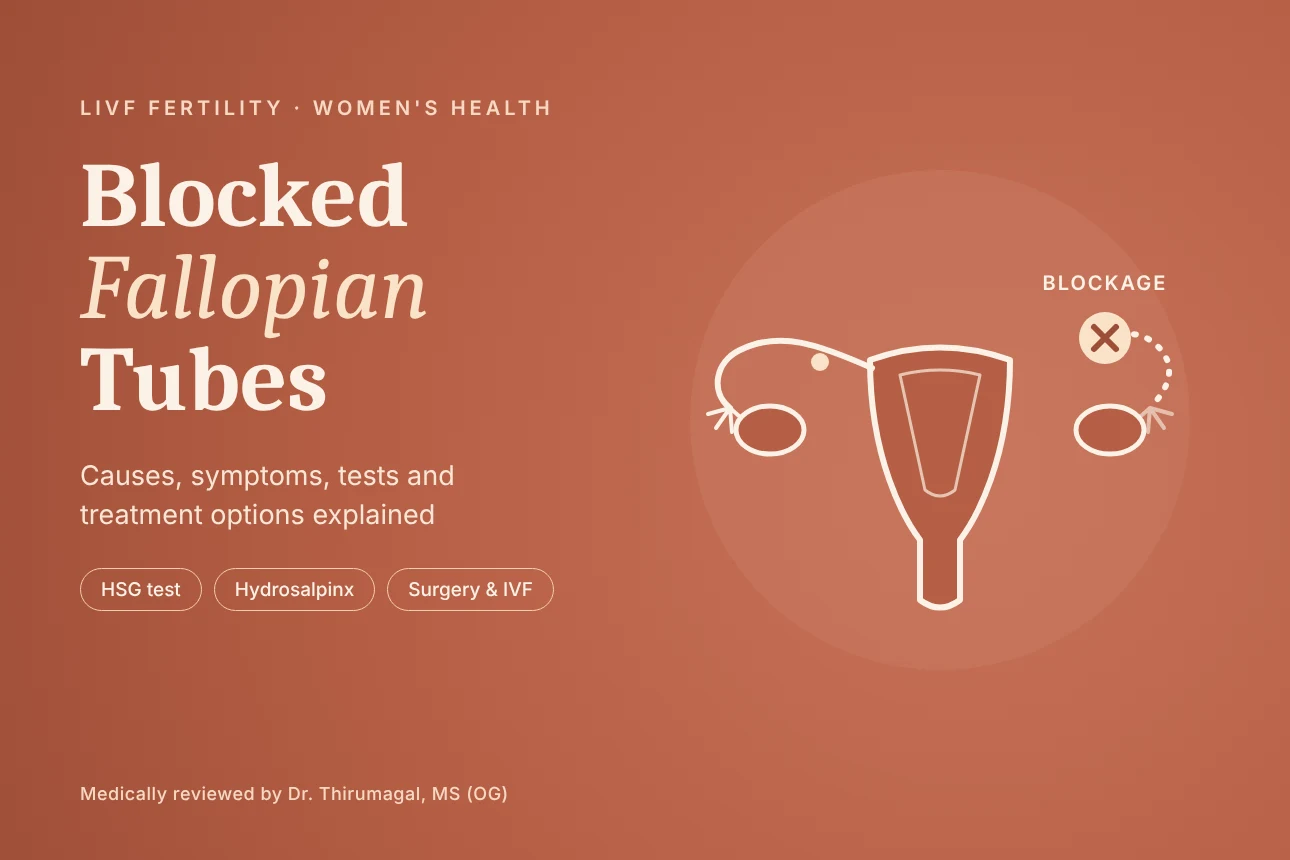
Each woman has two fallopian tubes, one on each side of the uterus. Every month, the tube near the ovary that releases an egg catches the egg. Sperm swim up through the uterus into the tube, and fertilisation happens inside the tube. The tube then gently moves the early embryo into the uterus over the next few days.
If a tube is blocked or damaged, the egg and sperm may not meet, or the embryo may not reach the uterus.
What causes blocked fallopian tubes?
- Pelvic infections (PID): infections such as chlamydia or gonorrhoea can scar the tubes, often without any symptoms at the time.
- Genital tuberculosis: an important cause in India. TB can silently damage the tubes and the lining of the uterus.
- Endometriosis: tissue and scarring around the tubes and ovaries can block or kink them. (Read: Endometriosis and Fertility)
- Previous surgery in the tummy or pelvis, such as surgery for appendicitis, caesarean section or ovarian cysts, which can leave adhesions.
- Previous ectopic pregnancy or surgery on the tube.
- Infection after abortion, miscarriage or delivery.
- Fibroids near the opening of the tube, in rare cases. (Read: Fibroids and Fertility)
Symptoms of blocked tubes
Most women with blocked tubes have no symptoms at all. The first sign is often difficulty getting pregnant. Some women may notice:
- Ongoing pelvic or lower tummy pain, especially with endometriosis or past infection
- Painful periods or pain during sex
- Unusual vaginal discharge, if there is an ongoing infection
- A history of ectopic pregnancy
Because symptoms are rare, tubal tests are a routine part of a fertility check-up.
What is a hydrosalpinx?
A hydrosalpinx is a tube that is blocked at the far end and filled with fluid. It often follows an old infection. This fluid can leak back into the uterus and make it harder for an embryo to implant, even during IVF. That is why doctors often advise removing or clipping a hydrosalpinx before IVF.
How are blocked tubes diagnosed?
| Test | How it is done | What it shows |
|---|---|---|
| HSG (hysterosalpingography) | A dye is passed through the cervix and X-ray pictures are taken | Whether the dye flows through each tube, and the shape of the uterus |
| SSG / HyCoSy | Saline or foam is passed into the uterus during an ultrasound | Tube flow, without X-ray |
| Laparoscopy with dye test | Keyhole surgery under anaesthesia; dye is passed and the tubes are seen directly | The most detailed check; endometriosis or adhesions can often be treated in the same sitting |
| Hysteroscopy | A thin camera looks inside the uterus | The tube openings from inside, and problems in the uterine cavity |
| TB tests | Tests on the uterine lining (endometrial biopsy) when TB is suspected | Whether genital TB needs treatment |
An HSG is usually done just after the period ends and before ovulation. It can cause cramps for a few minutes. Sometimes a tube looks blocked on HSG only because it went into a brief spasm, so a blocked result may need to be confirmed. (Read: HSG Test in Chennai: Procedure, Pain and What It Means)
Can you get pregnant with blocked fallopian tubes?
It depends on how many tubes are affected and how badly:
- One tube blocked, the other open and healthy: natural pregnancy is often still possible, because the open tube can pick up eggs from either side in many women. Ovulation tracking or IUI may be suggested, depending on the rest of your tests.
- Both tubes blocked: natural pregnancy is unlikely. Surgery may help in selected cases, and IVF is the most common route.
- Tubes damaged or filled with fluid (hydrosalpinx): the tube may need to be removed or clipped before IVF.
Tubes are only one part of fertility. Your doctor will also look at ovulation, egg reserve (AMH), the uterus and your partner’s semen analysis before suggesting a plan.
Treatment options for blocked tubes
| Situation | What your doctor may suggest |
|---|---|
| Block near the uterus (proximal), tube otherwise healthy | Tubal cannulation: a fine catheter is passed through the cervix to open the block, often with hysteroscopy |
| Adhesions or mild damage around the tube | Laparoscopic surgery to release adhesions or open the end of the tube |
| Hydrosalpinx before IVF | Removal (salpingectomy) or clipping of the damaged tube |
| Both tubes blocked or badly damaged | IVF, which bypasses the tubes: eggs are collected, fertilised in the lab and the embryo is placed directly in the uterus |
| Genital TB found | Full course of anti-TB treatment first, then fertility planning |
| Earlier tubal ligation (family planning operation) | Reversal surgery in selected cases, or IVF |
A few points to know:
- After tubal surgery, the risk of ectopic pregnancy is higher. If you conceive, an early scan is important to confirm the pregnancy is in the uterus.
- Age matters. For women in their late 30s, or when there are other fertility factors, doctors may suggest IVF sooner rather than waiting after surgery.
- There is no medicine, massage, herbal remedy or exercise that opens blocked tubes. Be cautious of claims that say otherwise.
Can blocked tubes be prevented?
Not always, but you can lower the risk:
- Get any unusual discharge, fever or pelvic pain checked early and complete the full course of treatment.
- Practise safe sex to reduce the risk of infections that scar the tubes.
- Get a check-up after a miscarriage, abortion or delivery if you have fever or pain.
- Don’t ignore painful periods. They can be a sign of endometriosis.
Frequently asked questions
Does an HSG test open blocked tubes? An HSG is mainly a test. Sometimes the dye flushes out a small block such as mucus, and a few women conceive in the months after an HSG, but it is not a treatment for true blockage.
Can I get pregnant naturally with one blocked tube? Often, yes, if the other tube is open and healthy and there are no other fertility problems. Your doctor may suggest trying naturally for some months, ovulation tracking or IUI.
Is laparoscopy needed for blocked tubes? Not always. Laparoscopy is advised when the HSG is unclear, when endometriosis or adhesions are suspected, or when surgery to open the tubes is planned.
Can blocked tubes cause pain? Most blocked tubes cause no pain. Pain is more common when the cause is endometriosis, an infection or a large hydrosalpinx.
Do I need to remove a hydrosalpinx before IVF? Doctors usually advise it, because the fluid can leak into the uterus and affect implantation. Your doctor will decide between removing or clipping the tube based on your scans.
Is IVF the only option when both tubes are blocked? IVF is the most common option because it does not need the tubes. In selected cases, such as a block near the uterus or a previous tubal ligation, surgery to open or rejoin the tubes may be considered.
The bottom line
Blocked fallopian tubes are a common reason for difficulty getting pregnant, and they usually cause no symptoms. Simple tests like an HSG can find them. With one healthy open tube, many women still conceive naturally. When both tubes are blocked or damaged, treatment options such as tubal surgery or IVF are available, and the right choice depends on your age, your scan findings and both partners’ tests.
Trying to conceive and worried about your tubes? Talk to our fertility team at LIVF Fertility & Women’s Healthcare about tubal testing and the right next step. Book a consultation at our Perungudi centre, behind World Trade Center, OMR · +91 78787 84079. We see patients from Perungudi, OMR, Thoraipakkam, Kandanchavadi, Velachery and nearby areas.
References
- Practice Committee of the American Society for Reproductive Medicine. Role of tubal surgery in the era of assisted reproductive technology: a committee opinion. Fertility and Sterility, 2021.
- Practice Committee of the American Society for Reproductive Medicine. Fertility evaluation of infertile women: a committee opinion. Fertility and Sterility, 2021.
- National Institute for Health and Care Excellence (NICE). Fertility problems: assessment and treatment (CG156), updated 2017.
- Johnson N, van Voorst S, Sowter MC, Strandell A, Mol BW. Surgical treatment for tubal disease in women due to undergo in vitro fertilisation. Cochrane Database of Systematic Reviews, 2010.
- Sharma JB. Current diagnosis and management of female genital tuberculosis. Journal of Obstetrics and Gynaecology of India, 2015.
This article is for general information and does not replace advice from your doctor.